
Innovation and Sustainability in Metal Construction: CRIARTE highlighted at Portugal Steel
- construcaocriarte
- Jan 5
- 3 min read

On June 4th, the Porto Higher Institute of Engineering (ISEP) hosted a conference dedicated to innovation, new technologies, and sustainability in metal construction. The event, co-organized with the CMM (Portuguese Association of Metal and Mixed Construction), brought together academic and industrial experts in a cross-disciplinary dialogue about the future of the sector.
The opening session was led by Eng. Luís Figueiredo Silva (CMM), with an institutional presentation of the Portugal Steel program, which has established itself as a driving force for the modernization of the metal sector in Portugal. The initiative stands out for promoting collaborative innovation between industry and academia.
Session 1 – New structural and technological approaches
Moderated by André Dias (Inesc-Tec), the first session featured contributions from three research projects with a strong technological component.
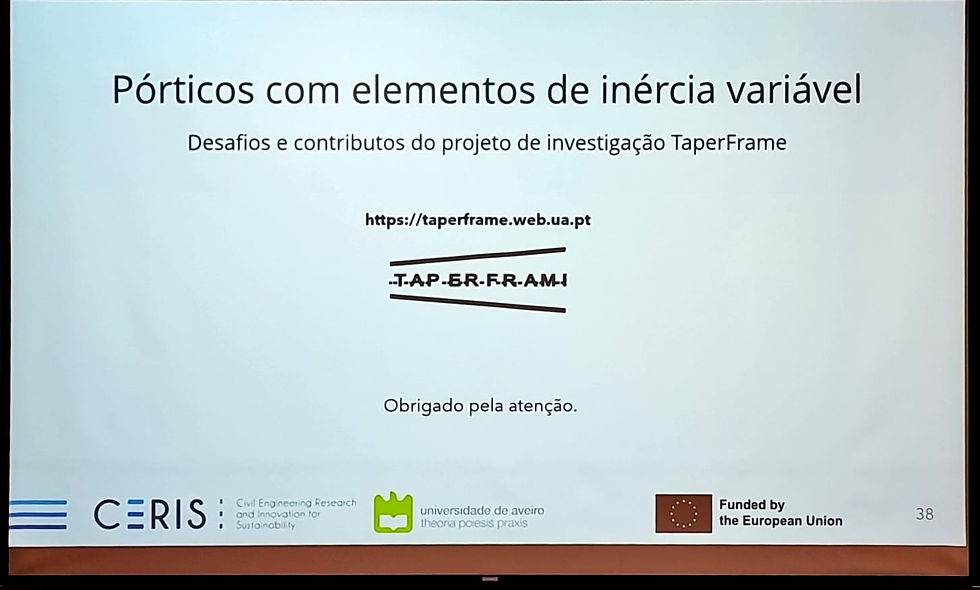
Carlos Couto (University of Aveiro) presented the challenges and advances of the TaperFrame project, focused on frames with variable inertia elements. The approach can bring significant benefits in terms of structural optimization, including fire resistance.
Cost reduction in the construction of these portals is supported by the characterization of residual stress limits or geometric imperfections in complex numerical models or laboratory tests.
Micael Couceiro , from Ingeniarius , the leading entity in the consortium in question, presented the CRIARTE project, which explores human-robot collaboration in the assembly of metal structures. Communication between robots and workers, based on artificial intelligence algorithms, aims to increase efficiency and safety on construction sites. Among several contributions, the development ambitions of CRIARTE in relation to the FORTIS project were presented.
The introduction of collaborative systems could transform on-site assembly into a semi-autonomous process, with a significant reduction in errors and accidents.

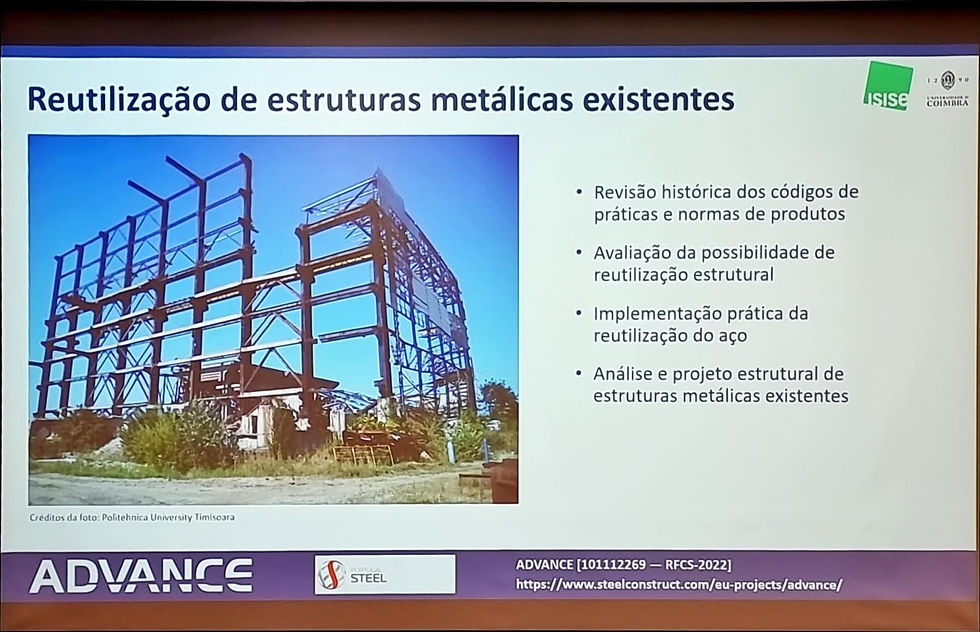
Helena Gervásio (University of Coimbra) shared the objectives of the ADVANCE project, which focuses on the reuse of metal structures. The proposed recommendations can shape circular economy policies in construction.
Disseminating best practices in deconstruction could be key to creating a secondary market for structural steel, contributing to the carbon neutrality of the sector.
Session 2 – Challenges of industrial practice and application
The second session, moderated by Rodrigo Falcão (ISEP), focused on more applied challenges, coming from both academia and industry.
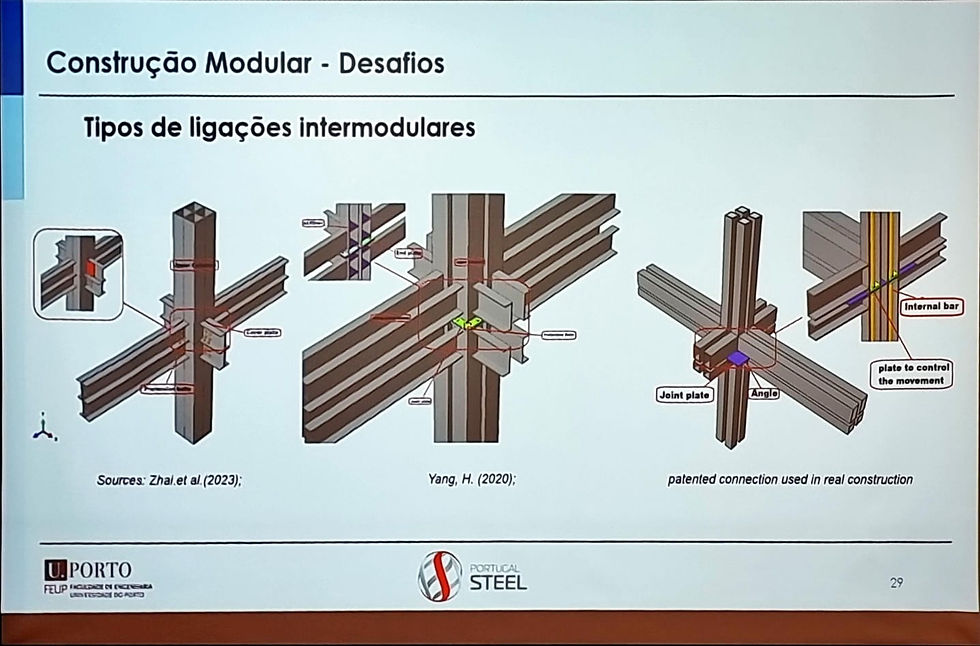
Miguel Castro (FEUP) addressed the seismic design of metal structures in the context of modular construction. The complexity of the connections and energy dissipation were some of the central points, which are highly dependent on the structural system adopted.
Integrating seismic requirements into modular solutions is a challenge that must be overcome to enable the safe and rapid construction of housing in Portugal.
Isabelle Ietka (Metalogalva) presented the lighting tower project for the Romareda Modular Stadium , demonstrating production capacity and innovation in the design of large lighting structures.

Gonçalo Martins (Perfisa) concluded the lecture series with a practical overview of the Light Steel Framing (LSF) system, highlighting several recent innovations and their impact on sustainability, performance, and ease of execution. He emphasized the spirit of continuous improvement and transparency, vital for a construction sector seeking to reinvent itself.
SKINIUM is a modular, multi-layered system for constructing exterior walls in LSF (Light Steel Framing) with different finishes, developed by a large consortium of four brands - PERFISA, Gyptec, Amorim and Mapei.

Acknowledgments
The consortium involved in the research presented by Micael Couceiro (Ingeniarius) is proud to contribute to a more efficient, safe, and sustainable future for metal construction. We appreciate the invitation to participate in this relevant and inspiring event. May these insights foster future collaborations and continuous innovation in the sector.


Comments